
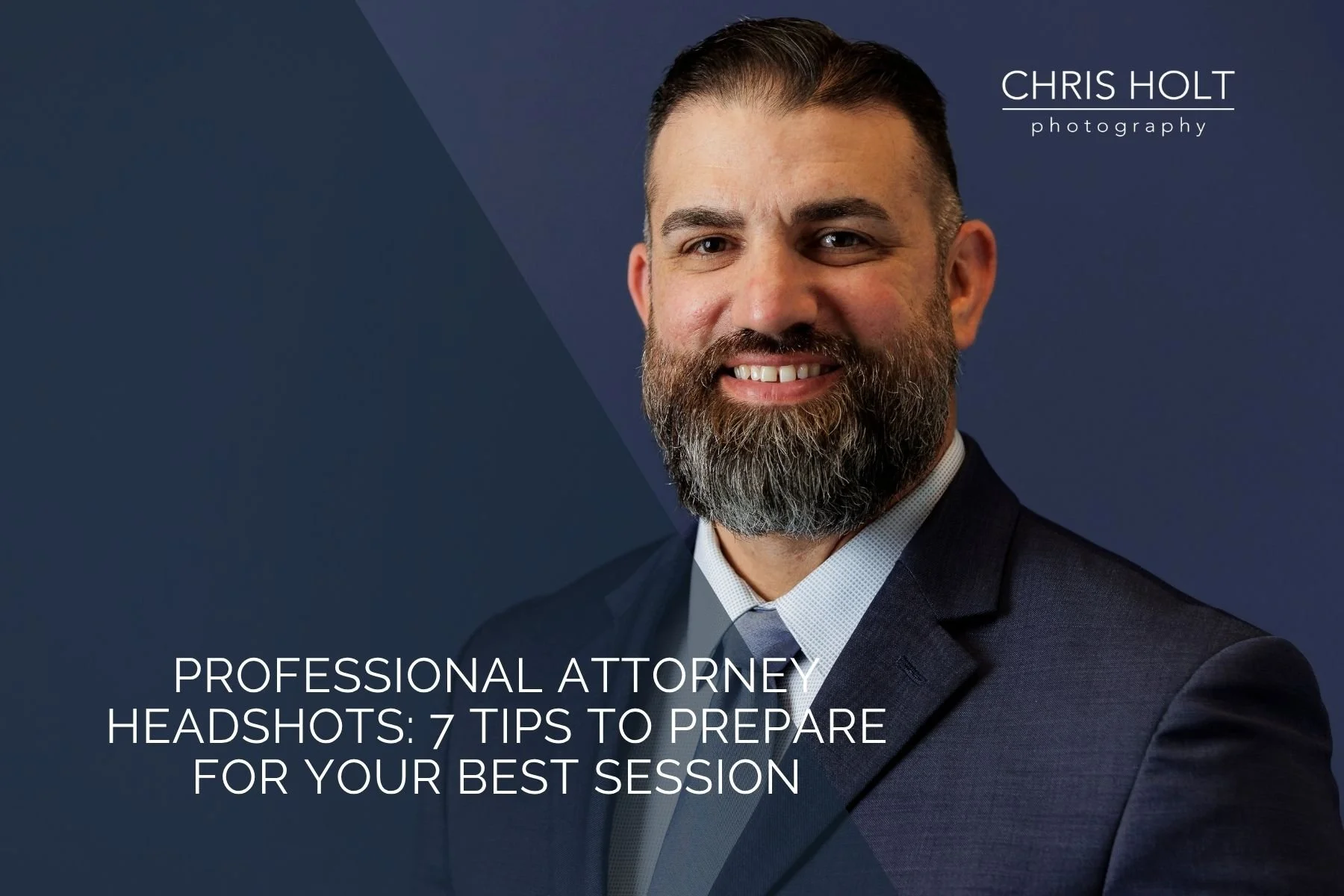
Professional Attorney Headshots: 7 Tips to Prepare for Your Best Session
In This Article
Tip 1: Decide what you want your headshot to communicate
Tip 2: Match your preparation to your practice area
Tip 3: Plan your wardrobe before the day of your session
Tip 4: Schedule your haircut at the right time
Tip 5: Prepare your skin, sleep, and energy in the days before
Tip 6: Know what happens when you walk in
Tip 7: Bring the right things and avoid the mistakes that cost you
Professional attorney headshot services at Chris Holt Photography
A headshot session is one of the few things in your professional life where the preparation you do beforehand has an almost direct relationship with the quality of what you get out of it.
Unlike a deposition you can recover from in real time, or a brief you can revise before filing, a headshot session gives you one window. The images you leave with are the images you use. What you bring to that session, in terms of wardrobe, mindset, and preparation, shapes everything.
The attorneys I photograph who walk away with their strongest images are almost never the most photogenic ones. They are the ones who showed up prepared. Here are the seven things that make the biggest difference.
Tip 1: Decide What You Want Your Headshot to Communicate
This is the step most attorneys skip entirely, and it is the one that separates a forgettable headshot from one that actually works.
Before you think about wardrobe or logistics, spend five minutes on this question: when the right potential client sees this photo, what do you want them to feel? Confident you can handle their situation? Approachable enough to pick up the phone? Authoritative enough to trust with something that matters?
The answer is different depending on your practice area, your career stage, and who you are trying to reach. A criminal defense attorney trying to signal strength and advocacy needs a different image than a family law attorney trying to communicate warmth and stability. Neither is wrong. But walking into a session without knowing which direction you are heading means your photographer is guessing, and guessing shows in the final images.
Write down two or three words that describe how you want to come across. Share them with your photographer at the start of your session. That simple step changes how they direct your expression, your posture, and the overall feel of the shoot.
Your headshot is doing a job every day on your firm website, your LinkedIn profile, your bar directory listing, and every speaking bio or press release that goes out with your name on it. The clearer you are about what job you need it to do, the better it will perform.
Tip 2: Match Your Preparation to Your Practice Area
One of the most common mistakes attorneys make is preparing for a generic professional headshot when what they actually need is one that speaks directly to their clients. The expectations your clients bring to their first impression of you vary significantly depending on what you do. Your headshot should meet those expectations, not work against them.
Corporate and transactional attorneys serve institutional clients and sophisticated counterparties who expect polish and precision. A traditional, composed presentation with conservative attire and a clean studio background communicates exactly what those clients are looking for: stability, attention to detail, and quiet confidence.
Litigation and trial attorneys need images that project strength and conviction. Clients coming to a trial attorney are often facing something serious and need to believe you will fight for them. A more direct expression, strong posture, and an authoritative overall presence serve this practice area better than a warm, soft look.
Family law and estate planning attorneys work with clients at some of the most emotionally difficult moments of their lives. Approachability matters as much as professionalism here. A slightly warmer expression and less rigid styling can be the difference between someone feeling comfortable enough to call and someone clicking away to find an attorney who seems easier to talk to.
Employment and personal injury attorneys often represent clients who feel wronged and need both empathy and resolve from their attorney. Your headshot should communicate that you take what happened to them seriously and that you will advocate hard on their behalf.
Real estate and business attorneys serve clients across a wide range of sophistication levels, from first-time homebuyers to commercial developers. A style that is approachable without being informal tends to work well across that range.For a detailed breakdown of how wardrobe choices should reflect your practice area, the professional dress code guide for attorney headshots covers it thoroughly.
Tip 3: Plan Your Wardrobe Before the Day of Your Session
Wardrobe decisions made the morning of your session are almost always the wrong ones. Give yourself time to think through this ahead of the shoot.
Bring two to three complete outfits. What looks right in your bathroom mirror may photograph completely differently under studio lighting. Having options means you are not locked into a choice that does not work once you see it on camera.
Stick with solid colors. Patterns, stripes, and textured fabrics compete with your face in a tightly cropped headshot. Navy, charcoal, deep burgundy, and medium gray photograph well and read as authoritative across virtually every practice area.
Avoid pure white and pure black as your primary color. White can blow out under bright studio lighting. Black flattens and loses detail. Off-white, cream, and light gray work better for lighter looks. Dark charcoal and navy work better than true black for darker ones.
Dress for the role you want to project, not just your current title. Your headshot will be in use for two to three years. Think about where you want your practice to be in that window and dress to match it.
Fit matters more than the label. A well-fitted suit at any price point photographs better than an expensive one that pulls at the shoulders or gaps at the collar. Check fit specifically at the shoulders, collar, and sleeve length before your session.
Bring a lint roller and wrinkle spray. Even freshly laundered clothing picks up lint and wrinkles in transit. A five-minute check when you arrive saves you from noticing a problem in your proofs that could have been fixed in thirty seconds.
Tip 4: Schedule Your Haircut at the Right Time
This is a small detail that makes a consistent, visible difference and almost everyone gets it wrong.
Schedule your haircut one to two weeks before your session, not the day before and definitely not the morning of. A fresh cut looks stiff and overly precise on camera. The shape is too clean, the edges too sharp, and it reads as someone who got ready for a photo rather than someone who always looks this way.
Give your hair a few days to settle back into its natural shape and movement before the session.If you color your hair, time your appointment so roots are not visible but the color has had a few days to soften from its freshest state. Bright, freshly colored hair under studio lighting can look artificially saturated in a way that draws attention away from your face.
The same principle applies to any significant grooming change. If you are considering a new beard, a new hairstyle, or anything else that represents a change from how you normally look, do it far enough in advance that it has become how you actually look before you walk into the studio.
Tip 5: Prepare Your Skin, Sleep, and Energy in the Days Before
The morning of your session is too late to address most of what shows up in photographs. The preparation that makes a visible difference happens in the three to four days before your shoot.
Stay hydrated. Skin tone and texture improve noticeably with consistent hydration. Start a few days ahead rather than drinking extra water only on the morning of your session.
Get a full night of sleep the night before your session. Fatigue is one of the hardest things to fix in post-production. Redness, puffiness around the eyes, and the low, flat energy that comes with poor sleep are all visible under studio lighting and difficult to retouch naturally without making you look like a different person.
For those who wear makeup: Stay close to your everyday professional look, slightly enhanced. Avoid heavy foundation or anything dramatic unless that is genuinely how you present at work. Translucent powder helps manage shine under studio lights. Bring your kit for touch-ups between outfit changes.
For facial hair: Trim and groom precisely one to two days before your session. Cameras capture detail at a resolution the naked eye misses in ordinary lighting. Whatever look you intend to project, make sure it is clean and deliberate.
Avoid anything new to your routine in the week before your session. New skincare treatments, spray tans, or dramatic changes to your appearance can create unpredictable results under professional lighting. You want to walk in looking like yourself, settled and confident, not like you tried something new.
Tip 6: Know What Happens When You Walk In
Knowing what to expect when you arrive removes the low-grade anxiety that shows up in the first fifteen minutes of a session.
When you walk into the studio, you will have a few minutes to settle in and do a final wardrobe check. Before the camera comes up, your photographer will have a brief conversation with you about your goals for the session, what the images will be used for, and what you want people to feel when they see them.
That conversation is more valuable than most attorneys expect. The context you provide shapes every decision your photographer makes, from lighting setup and background selection to how they direct your expression. Come prepared to share two or three words that describe how you want to come across, a sense of which platforms you will use the images on, and any reference images you found that resonated with you.
From there, the session moves through lighting, backgrounds, and a series of looks that vary your expression, posture, and wardrobe. Most individual sessions include two to three outfit changes.
Do not be alarmed if the first ten to fifteen minutes feel stiff. That is completely normal and expected. A good photographer knows how to ease that through conversation and direction rather than asking you to perform. Most attorneys hit their stride within the first few looks, and the images toward the end of the session are almost always the strongest ones.
Plan for the session to run about an hour. Do not book anything immediately after. Rushing creates a kind of background tension that shows in photographs in ways that are subtle but real.
For a full walkthrough of what happens from the moment you arrive through image delivery, the what to expect during your headshot session resource page covers it in detail. If you want to see examples of what a well-prepared session can produce, the headshot portfolio is worth reviewing before your appointment.
Tip 7: Bring the Right Things and Avoid the Mistakes That Cost You
What to bring:
Two to three complete outfits with appropriate accessories for each. A lint roller. Wrinkle spray or a small travel steamer. Your makeup kit if applicable for touch-ups between looks. A bottle of water. Any reference images you want to share with your photographer. A clear sense of the specific platforms the images will be used on.That last item matters more than most attorneys expect. Knowing the images will appear on your firm website, your LinkedIn profile, a bar directory listing, and a speaking bio helps your photographer make decisions about framing and variety that serve all four uses rather than just one.
Mistakes that quietly hurt your results:
Wearing something brand new for the first time. New clothing that has not been worn in will not move or sit the way you expect it to. Break everything in before the session.
Scheduling the session during a high-pressure period. If you are in the middle of a difficult case, a contentious deal, or anything else that is genuinely weighing on you, that stress will show. Schedule during a period when you are feeling settled if you have any flexibility.
Coming in right after a packed morning. Give yourself fifteen to twenty minutes of buffer before your session to decompress and reset. Walking in flushed and rushed sets the wrong tone for the first third of the shoot.
Over-correcting your appearance before you arrive. Heavy self-applied corrections or makeup designed to cover everything will look like exactly that on camera. Natural is always better. Your photographer handles retouching in post-production.
Not speaking up during the session. If something does not feel right, say so. The session is collaborative, and your photographer cannot read your mind. Honest feedback in real time produces stronger images.
Professional Attorney Headshot Services at Chris Holt Photography
I photograph attorneys, partners, associates, and law firm teams across Southern California, including clients in Rancho Cucamonga, Ontario, Newport Beach, Los Angeles, and throughout the Inland Empire.
Sessions are built around the needs of busy legal professionals. Most individual attorney sessions run about an hour and include multiple wardrobe looks and background options. You leave with high-resolution files for print and web-ready versions that work across every platform where your name appears.
Turnaround is three to five business days.
If you are coordinating headshots for a team of attorneys or an entire firm, on-location sessions bring the studio to your office so no one has to leave the building. Learn more about law firm and corporate team headshot sessions and what that process looks like.
For a broader look at how professional headshots shape client trust and firm brand, the complete guide to law firm headshot photography is a good resource to review.
Ready to Book Your Attorney Headshot Session?
If your current headshot no longer reflects where you are in your practice, now is a good time to change that.
To get started, email info@chris-holt.com or visit chris-holt.com to learn more about sessions and pricing. I am glad to help.